Wedding DJ Pricing in Canada: What a DJ Really Costs and How to Compare Quotes
October 26, 2026
Two wedding DJs in the same city can quote thousands of dollars apart - and both can be fair. Here is what a DJ price actually includes, why quotes vary so much across Canada, and the ten questions that reveal what you are really paying for.
The music is the one vendor your guests will experience every single minute of your reception, and it is also one of the most confusing services to price. Two DJs in the same city can quote numbers that are thousands of dollars apart, and both quotes can be completely legitimate. If you are planning a wedding in Canada and trying to figure out what a wedding DJ should cost, this guide breaks down what you are actually paying for, why quotes vary so much, and how to compare two very different proposals fairly.
What a Wedding DJ's Price Actually Includes
A professional DJ's quote is not just "show up and play songs." A full-service wedding DJ package typically covers the hours you book on the dance floor, but also hours you never see: the planning conversation where you map out your first dance, parent dances, must-play and do-not-play lists; the setup and sound check well before guests arrive; the teardown after the last song; and, in many packages, acting as your master of ceremonies — announcing the grand entrance, toasts, dinner service, cake cutting and the transitions that keep the night moving.
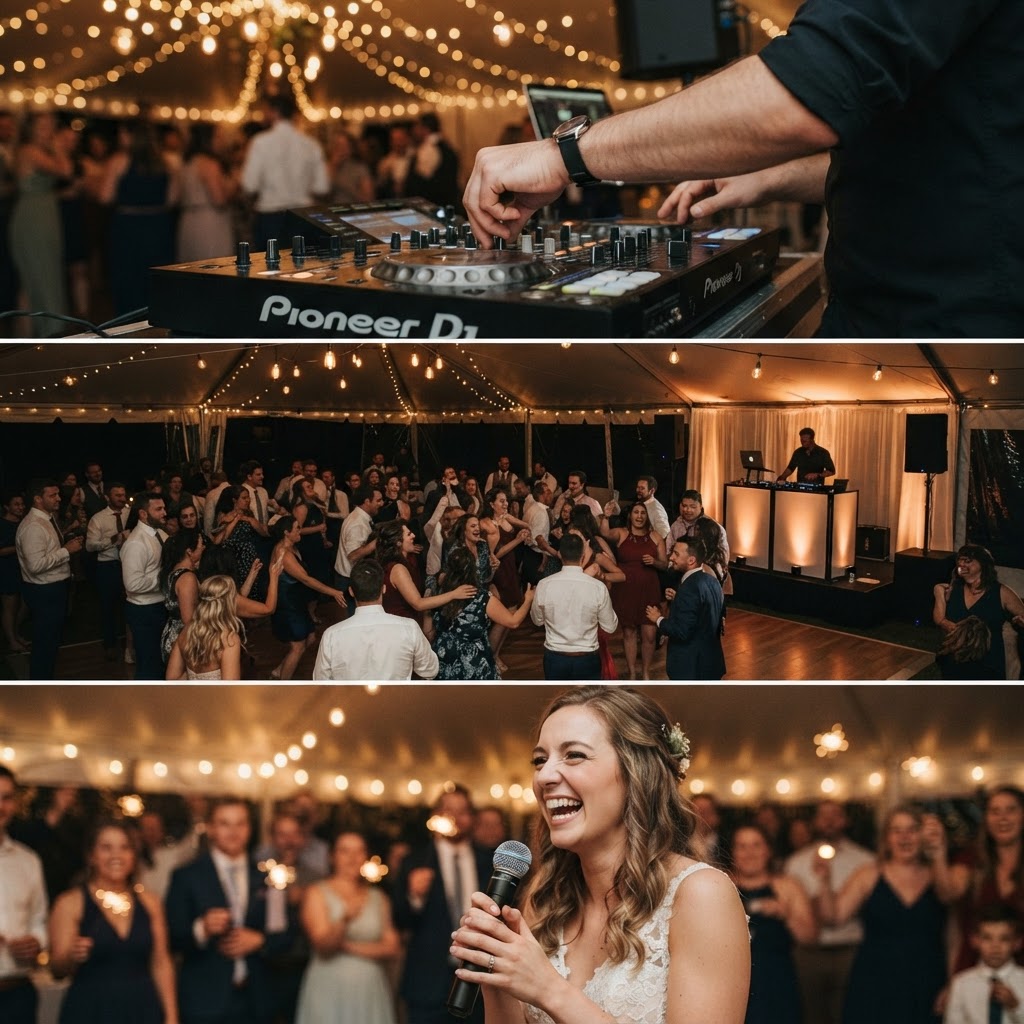
Equipment is the other invisible line item. A quality sound system sized to your venue, backup gear, a microphone for speeches, and often dance-floor lighting are usually bundled into the price. Some DJs include uplighting or a monogram projection; others charge those as add-ons. Travel matters too: a DJ driving two hours outside the city may build mileage and accommodation into the quote, or bill it separately. When you compare prices, you are really comparing several services rolled into one number.
Why DJ Quotes Vary So Much
The spread in wedding DJ pricing in Canada is real, and it usually comes down to five factors.
Experience and demand. A DJ with fifteen years of weddings, a full calendar and strong reviews prices higher than someone building their business. You are paying for a night that runs itself — a pro who reads the room, fixes timing problems before guests notice them and has a backup plan for every failure mode.
Date and season. A Saturday in June, July, September or October is peak wedding season in most of Canada. A Friday, Sunday, a winter date or a holiday-weekend off-peak can come in noticeably lower, simply because demand is softer.
Region. Costs in Toronto, Vancouver, Calgary and Montreal generally run higher than in smaller centres and rural areas, reflecting both cost of living and the depth of the local professional market.
Solo operator versus company. A single owner-operator often costs less than a multi-DJ agency, though an agency may offer more backup security if your DJ falls ill. Neither model is automatically better; you are comparing individuals either way.
Scope. Four hours of reception music is a very different job from ceremony sound, cocktail-hour music, a full reception, MC work, lighting and a late-night finale. Many "expensive" quotes simply include more of the day.
Typical Price Ranges in Canada
Exact prices vary by region and year, but couples planning Canadian weddings generally see the following structure. Ceremony-only sound and music — a speaker, a microphone and a processional playlist — is usually a modest add-on, often in the few-hundred-dollar range, and many DJs only offer it bundled with reception service. A standard reception package covering roughly four to six hours, with MC work and a basic sound system, typically sits in the middle of the market. A premium package adding dance-floor lighting, uplighting, extended hours, ceremony and cocktail coverage can easily run one-and-a-half to two times the base figure. As a rough planning anchor, most established full-service wedding DJs in Canadian cities quote in the low-to-mid four figures for a complete reception package, while newer or part-time DJs may quote well under that to build their portfolios. If a quote seems far outside those shapes — dramatically below everyone else or triple the rest — treat it as a question, not a bargain or a rip-off, and ask what drives the number.
The Questions That Reveal What You Are Really Paying For
Before you commit, ask any DJ these questions:
- How many hours does the quote cover, and what happens if the night runs long? Is overtime billed, and at what rate?
- Is MC work included, and who makes the announcements if not?
- Is a planning meeting or online planning tool included, and how many consultations do I get?
- What exactly is included in the sound system, and what lighting is extra?
- Do you bring backup equipment on-site?
- What is your policy if you cannot attend — a named substitute, a company guarantee, or nothing?
- When do you set up and tear down, and are those hours billable?
- How do you handle requests from guests, and how do you work with our do-not-play list?
- What deposit do you require, when is the balance due, and what is the cancellation and refund policy?
- Have you worked our venue before?
Straight, confident answers to all ten are a very good sign. Evasiveness on the illness, overtime or cancellation questions is where trouble usually hides.
How to Compare Two DJ Quotes Fairly
Put both quotes on the same grid: total hours of performance, hours of setup included, ceremony and cocktail coverage, MC work, lighting, travel, overtime rate, and payment terms. Normalize both to the same day shape — if one quote is for six hours and the other for four, add the first one's overtime rate to make them comparable. Then look at the two numbers that matter most for value: what happens if the DJ gets sick, and what the contract actually promises. A slightly higher quote that names your DJ, guarantees a substitute and includes the overtime rate in writing is usually worth more than a cheaper quote with vague answers. Cheapest is not the same as least expensive; a night that stalls at 9:30 p.m. with no MC and blown speakers costs more than any discount saves.
Booking Smart: Timing and Contracts
Popular DJs in Canada book out anywhere from six to eighteen months ahead for peak Saturdays, so once your venue and date are set, entertainment belongs in your first wave of bookings alongside photography. Get the agreement in writing every time: the date and venue, hours, equipment, lighting, MC duties, deposit and balance schedule, cancellation terms, and the illness-or-emergency clause. Read the cancellation policy carefully — a deposit that becomes fully non-refundable the moment you sign is different from one that refunds if the DJ can rebook the date.
The Short Version
A wedding DJ quote is a bundle: performance hours, planning, MC work, equipment, lighting and travel. Compare quotes on the same bundle, ask the ten questions, weigh the backup guarantee heavily, and book early for peak-season Saturdays. Do that, and the price you pay will feel obvious rather than confusing — and your dance floor will take care of itself.